

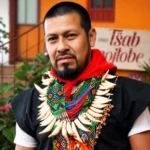
Gimar Lucitante was born on June 5, 1992, in La Dorada, municipality of San Miguel, Putumayo, Colombia. From a young age, he has been committed to Indigenous community organization and collective processes. He completed his primary, secondary, and technical education in the municipality of Valle del Guamuez.
Throughout his career, he has worked with Indigenous organizations and public institutions, contributing to community development initiatives, Indigenous governance, and territorial participation. He currently serves as Vice President of the Union of Indigenous Yagé Healers of the Colombian Amazon (UMIYAC), where he supports organizational strengthening, the defense of traditional knowledge, and initiatives that benefit Indigenous communities across the Colombian Amazon.
He is recognized for his commitment, sense of responsibility, and collaborative spirit, as well as for his continuous dedication to learning and contributing to the well-being and empowerment of Indigenous peoples.
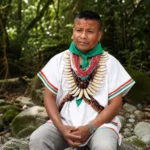
Ernesto Evanjuanoy is a follower of traditional medicine, an Indigenous leader, and a member of the Inga people of southwestern Colombia. He currently serves as president of the Union of Indigenous Yagé Healers of the Colombian Amazon (UMIYAC).
He has an extensive track record in defending the rights of Mother Earth, traditional healers, and the ancestral knowledge and medical systems of Indigenous peoples. His work focuses on protecting and strengthening Indigenous culture, territories, and traditional knowledge in the face of indiscriminate extraction, commercialization, and transformation outside their spiritual, communal, and territorial contexts. Throughout his career, he has served as governor of his community and held important positions as a traditional authority.
Within a context shaped by Colombia’s armed conflict, he has led community-based initiatives and brought traditional medicine to communities deeply affected by violence. Through this territorial and community-centered work, he promotes peacebuilding, the healing of war-related trauma, and reconciliation between communities, their territories, and Mother Earth.

For the past 23 years, Benjamin De Loenen’s work has been dedicated to addressing critical challenges related to the globalization of ayahuasca and other traditional Indigenous medicines. His deepest commitment is to ensure that the path of collective stewardship strengthens all communities involved, fostering alliances between ancestral and Western knowledge systems in service of collective healing and a regenerative future
In 2009, Benjamin founded the non-profit ICEERS (iceers.org) as the principal vehicle to bring this mission into the world. From 2022, he served as Interim Co-Director of the Indigenous Medicine Conservation Fund (IMC.fund) during its formative years, until Indigenous Co-Directors assumed leadership in 2024.
He has also served on the Board of the Global Ibogaine Therapist Alliance, is the author of the documentary Ibogaine – Rite of Passage (2004) and Ayahuasca Reframed (2012), is a TEDx speaker, and has lectured at conferences worldwide.
Since 2019, Benjamin has focused on deepening his study of Indigenous onto-epistemologies through alliances with ancestral knowledge holders, with a commitment to bringing his life, relationships, and work into alignment with the learnings of this path.
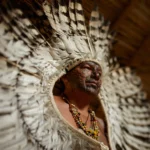
Nixiwaka Biraci Brasil Yawanawa is a renowned spiritual and political leader of the Yawanawa People in Acre, Brazilian Amazon. Throughout his life, he has been dedicated to preserving the culture, spirituality, and territorial rights of his people, with special attention to protecting the Amazon rainforest.
Under his leadership, the Yawanawa People obtained official recognition of their ancestral territory and initiated a cultural revitalization movement, focused on passing on traditional knowledge to new generations and expanding the dialogue with the world.
Since the 1980s, Nixiwaka has been an important voice in the Brazilian Indigenous movement, collaborating on the founding of Amazonian and Latin American Indigenous organizations. He is the president of the Nixiwaka Institute and one of the creators of the Indigenous Ayahuasca Conference.
His work is also distinguished by building bridges between ancestral knowledge and contemporary debates on sustainability and ecological balance. His leadership is marked by a commitment to preserving his people's memory and autonomy, ancestral wisdom, and the urgency of strengthening Indigenous voices on the global stage to build a world of peace and sustainability.
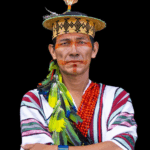
Benki Piyãko is an important leader of the Ashaninka People of the Amônia River, widely recognized as a social entrepreneur, environmental activist, and human rights defender. In addition to being an Indigenous spiritual leader, he is one of the founders of the Indigenous Ayahuasca Conference. As President of the Yorenka Tasorentsi Institute, in Marechal Thaumaturgo, Acre State, he carries out activities in reforestation of degraded areas, fish farming, and the education and awareness of local and global society about environmental protection and the strengthening of Indigenous culture.
As a guardian of the ancestral traditions of his people, Benki is committed to sharing knowledge about the forest, traditional medicine, and Ashaninka spirituality. He is an influential voice in national and international forums and coordinates local and global initiatives focused on environmental protection, including the preservation of river springs and the strengthening of Indigenous communities both in Brazil and in other countries. In addition, he is widely recognized for his wisdom, his ability to engage in dialogue, and his unwavering commitment to preserving the planet’s environmental and cultural heritage.

Attend